About
Resources
Product
About
Resource

Aluminium is essential to contemporary marine engineering and offshore construction. Selecting a material for shipbuilding, deep water structures, or designing engineering pipelines influences safety, corrosion resistance, service life, and considerations relating to long term costs. While many materials are available, including stainless steels, copper alloys, and mild steels, aluminium pipes are becoming the material of choice - mainly where durability, lightweight construction, and marine corrosion resistance are required.
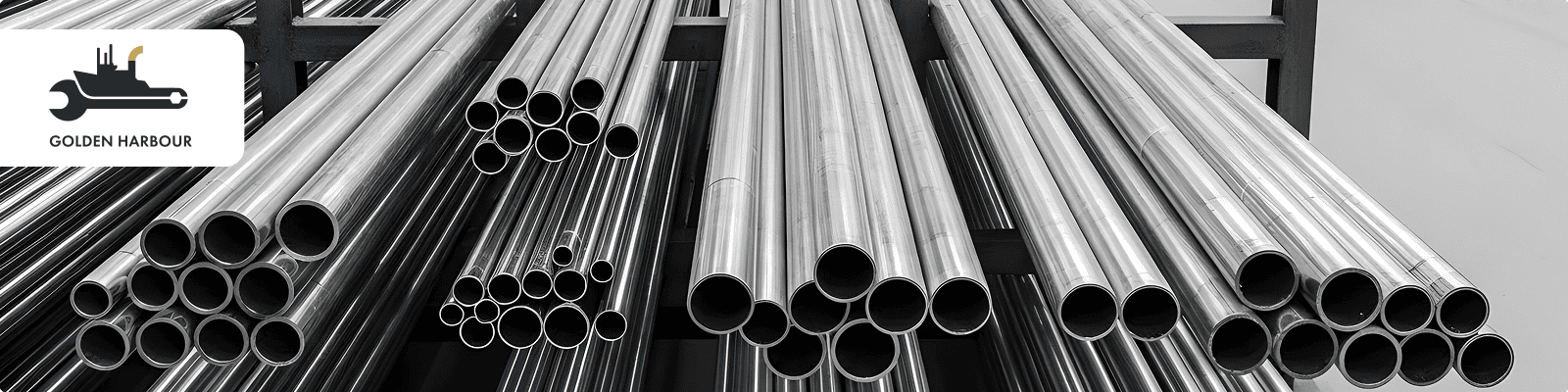
Presently, the demand for aluminium pipes for marine applications is experiencing increased usage in offshore structures, desalination plants, underwater systems, infrastructure, and shipbuilding. Coupled with their versatility, they provide aluminium offshore piping solutions for oil & gas, naval engineering, and marine renewable energy.
Aluminium pipes are hollow cylindrical tubes that are composed of engineered aluminium alloys with enhanced strength, corrosion resistant, and structural performance. Marine-grade aluminium pipes are used instead of regular consumer aluminium because they have superior equipment which allows them to endure:
With excellent strength-to-weight efficiency, aluminium has become a leading answer to why aluminium is used in marine engineering.
See also: Exploring Aluminium Bars: Their Types, Characteristics, and Applications
Saltwater is among the most corrosive natural environments. Mild steel will rust in a relatively short time frame, and stainless-steel pitting and localized corrosion will develop over time from when introduced into the environment.
Aluminium is special because:
For these reasons, many engineers considering material application for offshore projects are comparing piping options of aluminium vs stainless steel and will increasingly choose aluminium.
See also: Understanding Non-Ferrous Metal Alloys: Examples, Properties & Applications
Corrosion from seawater and UV exposure, high humidity, and many forms of weathering, is no match for marine-grade aluminium. With some care, aluminium pipe will perform in offshore environments for decades.
Its low density reduces vessel mass and increases payload capacity—supporting efficiency in ship construction. This aligns with one of the key advantages of aluminium in ship construction.
With the right alloy and care, aluminium pipes for offshore use maintain durability and performance for long-term marine operation.
Aluminium is easier to weld, bend, machine, and customize than many other metals.
While some alloys may cost more initially, the lifecycle savings in fuel efficiency, maintenance, and longevity make aluminium highly economical.
See also: Brass Bars in Marine Engineering: Why They Are the Trusted Choice!!
Aluminium pipes are widely used in industries that require lightweight, corrosion-safe solutions. Common applications include:
For many engineers and project managers sourcing materials, partnering with trusted aluminium pipe manufacturers and experienced aluminium pipe suppliers in UAE ensures compliance and reliability.
Compared to other metal types under marine conditions:
Stainless steel alloys - Protective but can develop chloride pitting over time.
Carbon steel alloys - Needs heavy / protective coatings and constant maintenance.
Copper alloys - Strong but expensive and considerably heavier than aluminium.
Aluminium is an acceptable compromise in protection, strength, weight, and cost, thus also making it tied with stainless steel for increasing popularity in marine engineering.
To ensure a maximum lifespan:
Rinse off salt build-up periodically.
Do not allow contact with any dissimilar metals to avoid issues created by galvanic corrosion.
Protective coatings can only be considered if the equipment will be submerged on a long term basis, otherwise is not recommended.
Inspect welds and joints at least annually for condition.
Provided that they are maintained properly, marine grade aluminium pipes can be used reliably in high pressure marine environments, such as offshore applications.

Aluminium pipes boast strength while weighing very little, have a long life span and are resistant to corrosion, making them a great material for shipbuilding, underwater systems and offshore works. The aluminium material is an advantage and increases durability and sustainability in marine engineering. This holds true whether in the marine transportation, energy, or infrastructure sector.
As well-established aluminium pipe suppliers in Dubai, Sharjah, and the UAE, Golden Harbour is supporting the aluminium pipe industry with a broad stock of vetted marine-grade products and sourcing partners of some of the world's leading aluminium pipe manufacturers. With more than 35 years supporting offshore construction, shipyards and industry throughout the region, Golden Harbour remains a trusted supply partner.
Aluminium is naturally corrosion resistant, and is substantially lighter than stainless steel; with those two factors at play, efficiencies are gained in marine engineering applications.
Depending upon the proper alloy and with a maintenance plan, marine aluminium pipes can last many years, even in extreme offshore service.
Rinsing the pipe to remove salt accretion, not using galvanic metals in close proximity to the pipe, and inspecting the pipe connections each year, are some steps that can dramatically increase the serviceability of marine pipes.
Yes, as long as the appropriate alloy grade and pipe type is specified according to the project.
Some high strength marine alloys, specifically designed for use offshore, afford the best performance, specifically in their corrosion resistance, which is important in the marine deployment.
Marine projects follow offshore engineering codes, safety regulations, and material-specific standards depending on application and region.