About
Resources
Product
About
Resource

Due to its combination of low density, adequate strength, good corrosion resistance, and excellent machinability, aluminium is quickly becoming one of the world's leading metals most commonly found in industry today. Aluminium bars are a widely accepted form of aluminium and are frequently used in mechanical and structural applications throughout many sectors of the economy.
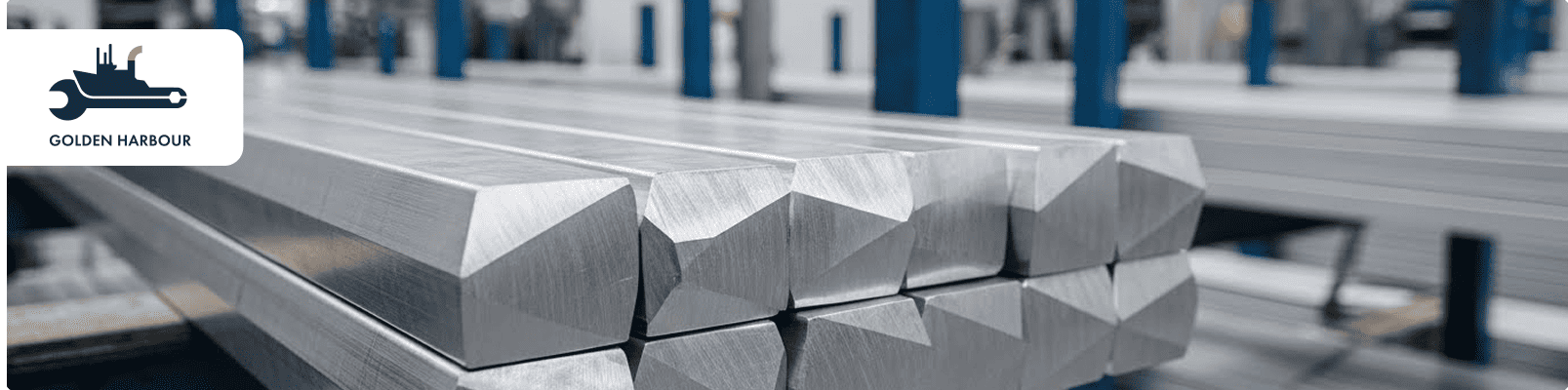
Aluminium bars are an excellent choice for all types of applications typically, heavy machinery and heavy machinery fabrication, etc. Are examples where aluminium bars help create lighter components without decreasing functional characteristics. The ability to provide a wide variety of shapes, sizes, and finishes, offers the manufacturer several options when creating aluminium bars. The push for more energy-efficient, sustainable, and durable products has enabled a number of businesses to switch to using aluminium rather than heavier, more maintenance-intensive metals.
This blog is designed to provide a broad overview of the various shapes of aluminium bars, including the most frequently used grades of aluminium bars, the various processes for manufacturing aluminium bars, and the many applications for aluminium bars across multiple industries.
Aluminium bars are produced as either solid metal parts made from aluminium alloys or hollow metal products that have been shaped into standardised cross-sections, and are intended to be used in many different types of industrial applications. As an aluminium bar will provide structural strength, ability to be machined, and resistance to corrosion in most types of industrial environments.
Depending on the specific needs of its application, an aluminium bar may be produced using one of three common methods, i.e., extruded, rolled or machined to specified dimensions. The strength-to-weight ratio of aluminium makes it ideal for use in industries that require high lasting value but prefer to avoid the added weight associated with steel or iron components.
See also: Exploring Aluminium Bars: Their Types, Characteristics, and Applications
Different shapes of alloy bars with distinct purposes according to load bearing and how to machine them. The following are the different types of alloy bars:
Round Bar (Aluminium): The Aluminium Round Bar is one of the most popular shapes, displaying the uniform diameter throughout the bar. Round Bars made of Aluminium can easily be machined, turned and drilled hence can be easily produced for use in parts such as shafts, pins, fasteners and mechanical components.
Square Bar (Aluminium): The Aluminium square bar is typically used to create structural frames, brackets and other devices requiring the load to be distributed evenly across a flat surface.
Hexagonal Bar (Aluminium): The Aluminium Hex Bar, commonly known as the aluminium Hexagonal Bar, is mostly used in assembly applications requiring grip and torque resistance for components such as fasteners, nuts and precision components.
Aluminium Flat Bar - These are commonly used in construction and fabricating support structures. The aluminium Flat Bar is used for framework, bases, and reinforcing materials due to their flat surfaces being ideal.
Hollow Square Bar - The aluminium Hollow Square Bar enables structural strength with less weight. Commonly used in architectural applications, transport frames, and support equipment to provide additional strength at a lower weight.
Solid Bar - The Aluminium Solid Bar is preferred when a higher-load-bearing capacity and machining precision will be necessary. Solid Bars are often used in mechanical, industrial applications.
Aluminium bars are available in several shapes, each serving a specific purpose based on load, design, and machining requirements.
Aluminium bars come in various alloys, each having unique performance properties:
1xxxx - High Purity Aluminium
3xxxx - High Strength, Easy to Work
5xxxx - Very Corrosion Resistant in Marine Environments
6xxxx - Good Strength, Machinable and Corrosion Resistant
7XXXX - Heavy-duty aerospace and engineering alloys with the highest strength
By selecting the correct alloy, you can expect your Aluminium Bar to perform consistently and dependably in various environmental and mechanical environments specific to your needs and how you will use it.
Controlled production techniques create consistent performance and properties among Aluminium Bars.
Together these processes allow Aluminium Bars to meet stringent industrial specifications.
The use of controlled manufacturing methods helps ensure the reliable properties and performance of Aluminium Bars.
Extrusion is the method of forcing molten Aluminium through a die. In doing so, Extrusion produces a uniform cross-section.
Rolling refers to an operation in which metal is formed into flat bars or structural sections.
Heat Treatment is a procedure performed after the formation of Aluminium Bars to increase the strength and/or mechanical characteristics.
Cutting and Finish Operations ensure the dimensional and surface finishes of Aluminium Bars are identical.
By employing these processes, manufacturers are able to produce Aluminium Bars meeting the high standards associated with industrial specifications.
Aluminium rods are lightweight and strong, have excellent resistance to corrosion, are easy to machine and fabricate, have long-term service life with optimum maintenance, can be reused, and are environmentally sustainable.
In addition, aluminium rods are cost-effective throughout the life cycle of the product, which makes them much more desirable than heavier metals for many industries.
An appropriate aluminium product can be selected based upon:
To maximize performance and longevity, it is necessary that you understand how the product's geometries relate to its alloy grade and type of application.
A number of international guidelines exist that define the composition of aluminium bars as well as their mechanical properties and manufactured tolerances, and all of the aluminium bars produced by Golden Harbour are subject to these international guidelines, thus offering customers globally consistent, safe and compatible products across multiple industries.
Golden Harbour partners with established manufacturers to further confirm that their produced aluminium bars meet the current required industrial and marine quality standards.
See also: Understanding the Types, Properties, and Industrial Applications of Brass

The manufacture of Aluminium Bars follows the widely agreed upon international standards (ISO) that define Aluminium Composition, Mechanical Properties and Tolerances, etc., for aluminium bars and any other aluminium items. All manufacturers of Aluminium Bars make sure their products conform to these internationally accepted standards, giving customers in many different industries safe and compatible products.
Golden Harbour works closely with established manufacturers to ensure all Aluminium Bars provided are manufactured to the required quality standards for both Industrial and Marine applications.