About
Resources
Product
About
Resource

Valves are typically one of the most significant components of oil and gas production, although they are not always the largest item on a project list. Valves are necessary to control the flow of fluids through pipelines, storage systems, manifolds, and processing systems; if the right valve is selected for a given application, the operation will continue as expected. Otherwise, the wrong valve can result in leakage or erratic flow patterns and could lead to an operational shutdown at a high cost.
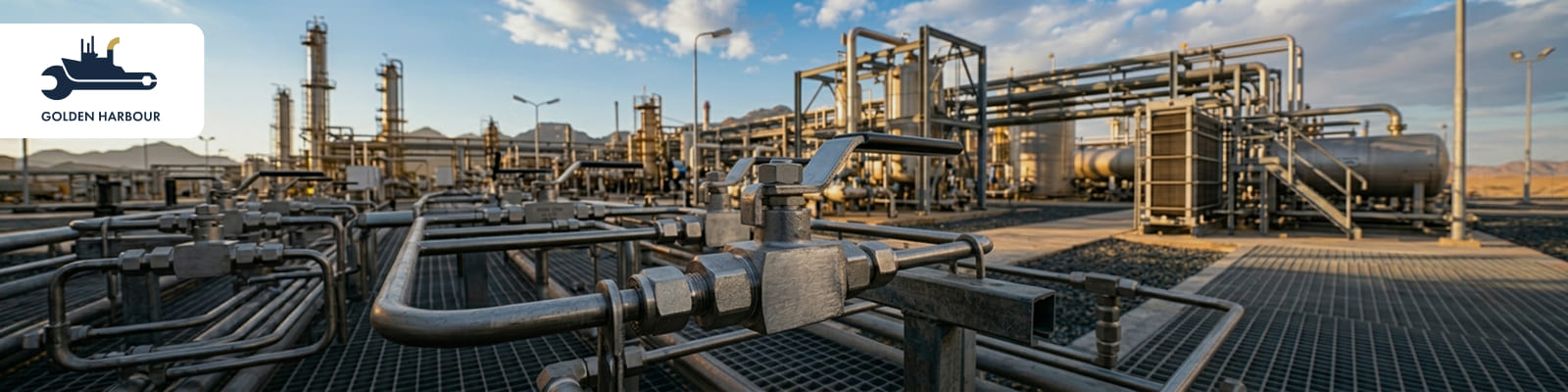
That is why selecting right high-pressure valves for oil and gas plants should never be treated as a routine purchase. Pressure class is only one part of the decision. Real performance depends on temperature, operating cycles, media compatibility, sealing reliability, maintenance access, and the role the valve is expected to perform inside the system.
For engineers and procurement teams, the best results usually come from combining sound technical selection with trusted industrial brands such as HOKE Ball Valves, HOKE Needle Valves, Circle Seal Relief Valves, and GO Regulators, all available through Golden Harbour for demanding industrial applications across the UAE.
This blog explains how to approach oil and gas high-pressure valve selection practically, with a focus on performance, safety, and long-term value.
Oil and gas facilities must function with minimal tolerance. Pressures fluctuate rapidly, temperatures increase dramatically, and certain types of fluids can corrode or wear away equipment. Just a small valve problem could be a major operational issue in an environment like this.
Valves that are difficult to operate or that leak under pressure or that wear out too quickly cause inconvenience for maintenance teams, but they can also disrupt production schedules, reduce efficiency, and cause increased life cycle cost.
This is why experienced operators look beyond price alone. They evaluate how the valve will behave six months, two years, or five years after installation. In many cases, spending more on the correct solution at the start prevents repeated replacement costs later.
Across upstream, midstream, and downstream facilities, valves perform different duties depending on the process.
High-pressure shutoff points commonly rely on HOKE Ball Valves for quick isolation and dependable sealing. Instrumentation panels and sampling systems often use HOKE Needle Valves where accurate flow regulation is critical. Automated shutdown systems frequently integrate Circle Seal Solenoid Valves for rapid remote response.
Typical applications include:
Many valve failures begin long before commissioning. They start during specification and procurement.
A valve may match the requested size and pressure rating, yet still be unsuitable for the real duty. This usually happens when the buying decision focuses on datasheet values while overlooking field conditions.
Common issues include poor material compatibility, selecting the wrong valve type, and ignoring overpressure risks. In many systems, correctly sized Circle Seal Relief Valves are essential for protecting pipelines, pumps, and vessels.
Not every valve is built for the same purpose. Matching the valve type to the duty is one of the most important parts of selection.
Where quick shutoff and minimal pressure drop are priorities, ball valves are a strong choice. Their quarter-turn operation allows fast response, and full-port designs help maintain flow efficiency. HOKE Ball Valves are widely used in high-pressure systems because they are engineered for reliable sealing and repeatable operation.
When flow must be adjusted gradually and accurately, needle valves are more suitable. They are common in instrumentation systems, sampling lines, and calibration setups. HOKE Needle Valves are trusted where fine control matters.
Applications requiring highly accurate low-flow adjustment often benefit from HOKE Metering Valves, particularly in gas analysis and dosing systems.
Where rugged operation and dependable shutoff are required, HOKE Plug Valves are often selected for switching or diverting flow paths.
Where leakage prevention and reduced maintenance are priorities, HOKE Packless Valves provide enhanced stem sealing reliability.
Pressure protection should never be an afterthought. Circle Seal Relief Valves are designed to release excess pressure before equipment damage or unsafe conditions occur.
Where downstream pressure must remain controlled despite changing inlet conditions, GO Regulators provide dependable pressure management across industrial gas and fluid systems.
A valve's performance can often be dependent on the choice of material. In a typical oil and gas environment, valves must contend with many different contingencies that can include exposure to sour gas, moisture, corrosive chemicals, high temperatures, and particles that can cause abrasive wear. Generally, stainless steel is the preferred material because of its ability to resist corrosion and provide a long-lasting durable valve. There are also applications in many marine and utility service applications that use bronze valves. Finally, cast steel valves are the most common material used to create heavy-duty industrial valves.
The key is not choosing the strongest material universally, it is choosing the most suitable material for the specific duty.
Pressure rating often receives the most attention, but sealing quality is what operators notice later.
Even minor leakage can create safety concerns, wasted product, and maintenance downtime. Engineered solutions such as ABV Series Ball Valves, 7100/7200 Series Ball Valves, 7G Series Ball Valves, and 7C Series Ball Valves are selected where dependable shutoff and long service life are essential.
A reliable high-pressure valve selection guide should always include certification and standards review.
Depending on the project, this may involve API requirements, ASME pressure classes, ISO manufacturing standards, and site-specific approvals. Certified solutions such as Circle Seal Relief Valves help facilities meet strict safety requirements across oil and gas operations.
The cheapest valve on a quotation sheet may become the most expensive valve in operation.
Procurement teams should consider maintenance frequency, spare part availability, downtime cost, and service life. Selecting durable solutions such as HOKE Packless Valves and serviceable HOKE Needle Valves often lowers lifecycle costs significantly.
Golden Harbour supplies trusted industrial solutions across flow control, instrumentation, and pressure management. This includes HOKE Ball Valves, HOKE Needle Valves, Plug Valves, Packless Valves, Circle Seal Controls, and GO Regulators for demanding oil and gas environments.
More importantly, the focus is not simply on supplying a catalogue item. It is on understanding the process duty and recommending a solution that performs reliably over time.
Selecting valves for oil and gas plants is not about choosing the most expensive product or the most familiar brand. The focus is on aligning the valve with the actual requirements of the system. When evaluating low or high-pressure, type of media, the frequency at which equipment is in operating cycles, the sealing requirements, temperature and pressure compatibility with materials, and the realities of maintenance all at the same time. The best possible choice can then be made.
Golden Harbour supplies safe, controlled, dependable, and reliable solutions for high-pressure industrial valve applications in both oil and gas Industries to companies requiring industrial use of high-pressure industrial valves.