About
Resources
Product
About
Resource

Bronze has been in use in engineered systems for hundreds of years, not because it's trendy, but because it works. In industrial and commercial environments, where parts are subjected to daily loading, friction, corrosion, and pressure, bronze alloys provide the sort of lasting service that industrial and commercial operations need and rely on.
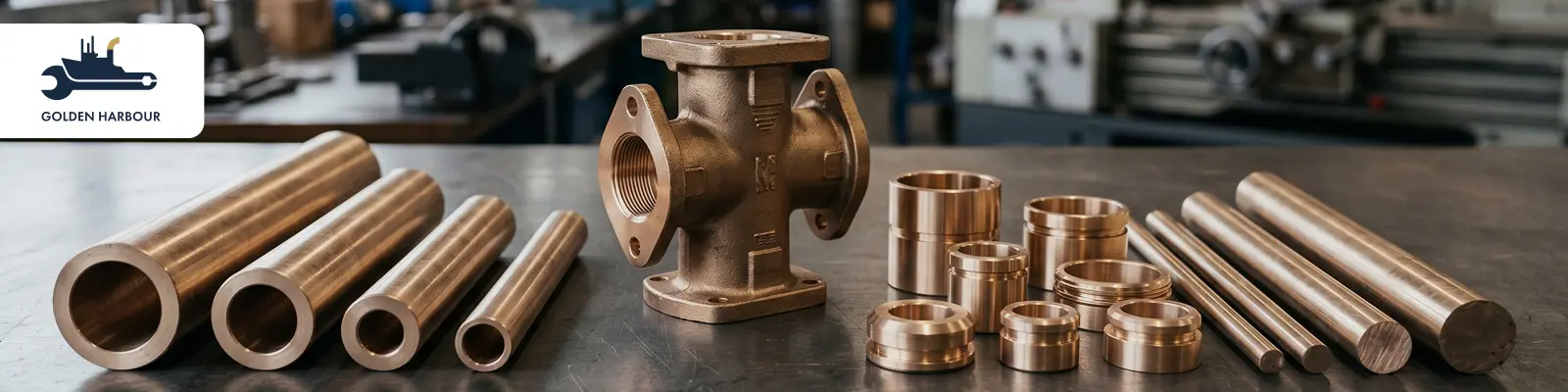
The correct choice of bronze alloy is not a single step either. Each family of alloys has its specific mechanical strength, corrosion resistance and workability. The wrong alloy selected could cause components which should work happily for many years to fail within a matter of months; the right one may work for years with minimal maintenance.
Bronze is a copper alloy and traditionally is defined as a copper alloy where tin is the main alloying element. Modern usage defines bronze as a broad classification for various copper alloys which have tin, aluminium, phosphorus, nickel, lead or silicon as the main alloying element; each gives a distinct set of properties.
Within each of its various alloy families, bronze maintains an invariable set of properties that makes it a good choice under harsh conditions:
These properties explain why bronze alloy remains in use across oil and gas, marine, hydraulic, and general industrial systems where operational integrity is paramount.
It is the standard engineering alloy. Its reliability with the right blend of wear resistance, pressure tightness and machinability fits a vast selection of general industrial components.
Bearings, bushings, valve seats and pump parts made from tin bronze provide constant performance under moderate load and when used with water, steam and dilute chemicals.
Phosphorous bronze builds on the tin bronze base, but the addition of phosphorus serves as both a deoxidiser and a strengthener. Thus, phosphor bronze is a much stronger, harder material than tin bronze and has a good spring back.
This leads to its widespread application where fatigue is a major consideration, such as in gears, worm wheels, heavy-duty bearings and spring contacts.
In an Aluminium bronze, aluminium replaces tin as the main alloying addition. This resulting alloy has a higher corrosion resistance, specifically when used in the marine environment, against oxidising acids and in a marine splash zone.
This is because a thin protective oxide film is formed on the alloy, which offers self-protection against hostile conditions.
The NAB range takes one step beyond the aluminium bronze range in corrosion resistance. The nickel and iron added to the copper-aluminium base result in this alloy's excellent seawater immersion and offshore use, plus high-pressure fluid systems.
NAB is often specified for Marine propellers, offshore valve bodies, subsea fittings, and oil & gas equipment, where mechanical strength needs to be coupled with high levels of corrosion resistance.
The inclusion of lead as a third constituent in bronze (leaded bronze) provides excellent self-lubricating capabilities. The lead particles are dispersed within the copper matrix, acting as an effective solid lubricant under the applied load.
This reduces friction and wear, making it possible to run bearings and bushings under intermittent or poorly lubricated circumstances. It is a preferred choice for bearings in heavy machinery and where lubrication is not guaranteed.
The simplest forms of bronze products are bronze bars and a round rod. These are the basic materials that all machined components, such as bearings, bushes, sleeves, spacers, valve seats or any part that will need turning, milling or drilling to size will be machined from.
Check out: Bronze Round Bars
A bronze hollow bar is a pre-machined cylinder that helps decrease the amount of machining time and waste generated when manufacturing hollow parts like bushings, liners and bearing sleeves.
Instead of a solid bar having to be bored out (which is a slow machining process), engineers can purchase a bronze hollow bar in a near-final dimension. This can mean quicker lead times and lower costs, especially with medium to larger diameter part sizes.
Check out: Bronze Hollow Bars
These provide flat stock material for fabricating wear plates, marine claddings, architectural fittings and sheet metal components which are either cut, formed, bent, or stamped. These are supplied as aluminium bronze and phosphor bronze sheets. These grades are best suited for structural and wear surface applications.
Check out: Bronze Sheets
Bronze flat bars lie between sheet stock and round bar - are suitable where a square or rectangular section is required to form welded or bolted fabrication for frames, structural liners, key stock, or wear strips. Being available cut to length, it requires very little secondary work to weld or bolt into an assembly, and therefore is ideal for workshop or site fabrications.
Bronze flanges and valves represent the technical end of the Bronze family. Valves (gate, globe, ball and check) made from Bronze are the norm for fluid systems where pressure integrity and corrosion resistance are key. They are a tried and tested material for use in: Water distribution, marine systems, HVAC, and process pipework.
Check out: Bronze Valves
Begin with the mechanical requirements of the application. Is the part experiencing static, cyclic, dynamic or impact load? Medium, static load will be acceptable by Tin Bronze.
Phosphor Bronze is specified for cyclic or fatigue loading conditions. Nickel-aluminium bronze is specified for both high mechanical load and resistance to corrosion.
Components used in sliding contact bearings, bushings, gears and worm drives require an alloy capable of resisting wear.
The main choices for bearing use are leaded bronze and tin bronze, while Phosphor bronze should be used in high-cycle gear and worm applications, and Aluminium bronze offers resistance to abrasive wear in fluid use.
This is a vital point in most industrial applications in the UAE. Freshwater and mild chemical environments are covered by tin bronze. For seawater and high chemical environments, the selection of aluminium bronze should be the lowest requirement.
With continuous immersion and offshore operation, nickel-aluminium bronze is specified. Leaded bronze may be ideal for bearings, but must not be specified for corrosion environments.
Bronze alloys, on the whole, are good at medium to high temperatures. The upper working temperatures of tin and leaded bronze are around 200 °C.
Aluminium and nickel aluminium bronze hold their mechanical properties at higher temperatures and are the best selection for parts where thermal cycling, or operation at higher temperatures, is a consideration.
If the component needs to be machined to close tolerances, then machinability is important. Leaded bronze and tin bronze can be readily machined.
Aluminium bronze and nickel aluminium bronze are difficult to machine, requiring specific tooling and cutting speeds. This can be a factor in the choice if cost and time are limited.
For essential applications within the oil & gas, marine, pressure systems, etc., any engineering bronze alloys sourced should comply with known material specifications. Ensure that the particular alloy and product form being procured meets the required ASTM, BS or EN standard.
Reliable bronze material suppliers will furnish fully traceable mill test reports and certify to the required specification as a matter of course.
| Alloy | Best for | Strength | When to Avoid |
|---|---|---|---|
| Tin Bronze | Valves, bushings, bearings | Machinability, wear resistance | High-temperature |
| Phosphor Bronze | Gears, connectors, springs | Elasticity, fatigue strength | Price-sensitive projects |
| Aluminium Bronze | Valve parts, marine, pump | Wear and corrosion in seawater | Where machinability is critical |
| Nickel Aluminium Bronze | Oil & gas, offshore, marine | Corrosion-proof, high-strength | Standard wear applications |
| Leaded Bronze | Bushings and bearings | Self-lubricating | Potable water systems |
| Application | Alloy Recommended | Why Is It Suitable |
|---|---|---|
| Marine propellers & shafts | Nickel Aluminium Bronze | High corrosion resistance in seawater, strong under load |
| Hydraulic valve bodies | Tin Bronze / Leaded Bronze | Pressure-tight, easily machined to tight tolerances |
| Pump impellers | Aluminium Bronze | Erosion-resistant, performs in aggressive fluids |
| Gears & worm wheels | Phosphor Bronze | High fatigue strength, low friction against steel |
| Plain bearings & bushings | Leaded Bronze / Tin Bronze | Self-lubricating, reliable under sustained load |
| Oil & gas fittings | Nickel Aluminium Bronze | Pressure-rated, corrosion-proof in hydrocarbon environments |
Mistakes in selection are commonly made by even the most competent engineer, decreasing the reliability of a component or its cost over life. The most common errors to avoid are:
Whether your industrial business is in the oil, gas, desalination, marine, construction or manufacturing sectors in the UAE, the reliability of your material supply chain is as important as the material itself.
The trusted bronze metal suppliers do more than just shift material - they give you technical traceability and support the specific requirements of your project through International standard-based documentation.
For projects working with ADNOC, DEWA, or international engineering codes, material certifications, traceability to heat number and compliance data are required. Dealing with reputable bronze alloy suppliers who have experience of working to these standards eliminates any ambiguity with regard to supply and safeguards the project duration.
Golden Harbour is one of the reputed bronze alloy suppliers and provides all kinds of bronze products such as round bars, hollow bars, sheets, flanges, valves for industrial, marine and oil/gas consumers throughout the UAE. All materials are supplied with all documentation and in both standard and custom sizes as required.
Bronze alloy selection is not a guessing game. Every family of alloys have a certain performance characteristic that is associated with it, and fitting that characteristic to the application conditions determines if the component will work reliably for years or if it will fail early.
Start with the load. Consider wear conditions. Assess the corrosion environment. Confirm operating temperature range. Take into account the machinability. Check on the standards.
Systematic consideration like this would select the most appropriate material - be it a tin bronze for an ordinary bearing, an aluminium bronze for a marine pump part, or a nickel aluminium bronze for a marine valve body.
When chosen, specified and procured correctly, the correct bronze represents one of the most reliably predictable choices an engineer or procurement professional can make.